Wednesday, August 24, 2011

Carpenter Centre - Information and Le Corbusier Elements


A lot of pictures of different aspects of my matrix building the Carpenter Centre by Le Corbusier.

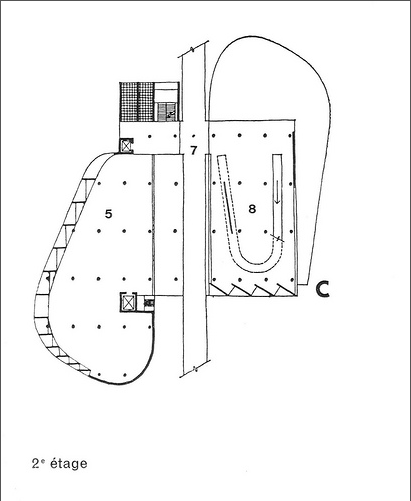
The Carpenter Centre for Visual Arts is situated at Harvard University in Cambridge, Massachusetts and is the only building designed by Le Corbusier in the United States. Le Corbusier designed it in collaboration with the Chilean architect, Guillermo Jullian de la Fuente, with the building being completed in 1962.

The building was constructed in response to a donation by the Carpenters, and today houses the Department of Visual and Environmental Studies of Harvard University as well as housing the Harvard Film Archive, the largest collection of 35mm films in New England. The building is essentially a cubic volume with interior diagonal studios extending out in opposite directions, intersected by a S-shaped ramp that rises from the center of the 3rd level leading to Quincy St on one side and Prescott St on the other. The building is in direct bold contrast to its neo-classical surroundings, standing out with a distinct modernist style and associated geometry. The building's floors and levels are attached to grids of concrete columns on the interior forming the majority of the structural building element, with open plan areas creating open free flowing spaces utilizing the mass and space of the building interior. Other influential Corbusian elements is the use of cylindrical piloti, the play of dark and light by the use of simple grid like windows, the elevation of the building from the ground, the mixture of curves and orthogonal lines in the building's exterior form and has been described as a building that encompasses a vast majority of Le Corbusier's theories.


Addresses of pictures:

http://www.artandarchitecture.org.uk/images/conway/396d2b90.html
http://www.artandarchitecture.org.uk/images/conway/0480fa9b.html
http://sdngnet.com/Gallery2/v/USA-2005-Mini/Boston/album06/Boston_Harvard_University_Carpenter_Centre_for_the_Visual_Arts_by_Corbusier_14_Mini.jpg.html
http://praxismakesperfect.tumblr.com/post/3054039093/carpenter-centre-le-corbusier-by-hagen-stier
http://www.artandarchitecture.org.uk/images/conway/b293027b.html
http://www.artandarchitecture.org.uk/images/conway/86b76d24.html
http://www.flickriver.com/photos/tags/carpentercenter/interesting/
http://www.archlab.tuwien.ac.at/~carpent/carpenter/texte/story/carp2.html

Tuesday, August 23, 2011

Linden Script to Make Pin Wheel Turn

// The code below was generated by
// SCRATCH FOR SECOND LIFE (S4SL)
// alpha release October 19, 2007
//
// by Eric Rosenbaum (ericr@media.mit.edu)
// MIT Media Lab
// Lifelong Kindergarten group
//
// S4SL is a modified version of Scratch,
// a graphical programming language for kids
// see scratch.mit.edu
//

//
// USER VARIABLES
//


//
// INTERNAL VARIABLES
//

vector home;
integer penState;
float penColor;
float color;
float ghost;
vector originalScale;
float sizePercent;
integer numAvatarsNearby;
vector nearestAvPosition;
key ownerKey;
vector ownerPosition;

//
// INTERNAL FUNCTIONS
//

// move(steps)
// move object a number of steps (meters) along its current heading
// forward is along the positive x axis
// if the pen is down, create a line segment along the path traveled
// the line is positioned by its center, which is placed halfway back along the path
move(float steps)
{
vector fwd = llRot2Fwd(llGetRot()) * steps;
llSetPos(llGetPos() + fwd);
if (penState == TRUE) {
if (llGetInventoryType("lineSegment") == INVENTORY_NONE) {
llSay(0, "Oops! To draw a line, my inventory needs a lineSegment. You can get one from the Scratch Inventory Box.");
} else {
integer randomID = llRound(llFrand(99999999));
llRezObject("lineSegment", llGetPos()-fwd/2, <0,0,0>, llGetRot(), randomID);
llSay(1, (string)randomID + ":set length:"+ (string)llFabs(steps));
llSay(1, (string)randomID + ":set color:" + (string)penColor);
}
}
}
// turnRight(float angle)
// turn angle degrees clockwise around the local z axis
turnRight(float angle)
{
angle *= -1;
rotation newRot = llEuler2Rot(<0,0,angle> * DEG_TO_RAD);
llSetRot(newRot*llGetRot());
}
// turnLeft(float angle)
// turn angle degrees counterclockwise around the local z axis
turnLeft(float angle)
{
rotation newRot = llEuler2Rot(<0,0,angle> * DEG_TO_RAD);
llSetRot(newRot*llGetRot());
}
//up(float steps)
//move up along the global z axis by steps meters
//does not leave a line segment
up(float steps)
{
llSetPos(llGetPos()+<0,0,steps>);
}
//down(float steps)
//move down along the global z axis by steps meters
//does not leave a line segment
down(float steps)
{
llSetPos(llGetPos()+<0,0,-1*steps>);
}
// turnPitch(float angle)
// turn angle degrees upward around the local y axis
turnPitch(float angle)
{
angle *= -1;
rotation newRot = llEuler2Rot(<0,angle,0> * DEG_TO_RAD);
llSetRot(newRot*llGetRot());
}
// float getHeading()
// return the current heading in the xy plane in degrees
float getHeading() {
return llRot2Angle(llGetRot())*RAD_TO_DEG;
}
// setHeading(float angle)
// set the heading in the xy plane in degrees
setHeading(float angle) {
vector newVec = <0, 0, angle*DEG_TO_RAD>;
rotation newRot = llEuler2Rot(newVec);
llSetRot(newRot);
}
// turnRoll(float angle)
// turn angle degrees clockwise around the local x axis
turnRoll(float angle)
{
rotation newRot = llEuler2Rot( * DEG_TO_RAD);
llSetRot(newRot*llGetRot());
}
// changePenColorBy(float num)
// change the pen color by an amount
changePenColorBy(float num)
{
penColor += num;
setPenColorTo(penColor);
}
// setPenColorTo(float num)
// set the pen to a particular color
setPenColorTo(float num)
{
penColor = (integer)num % 100;
}
// penDown()
// put the pen down, so that when the object moves it will draw
penDown() {
penState = TRUE;
}
// penUp()
// put the pen up, so that the object will not draw when it moves
penUp() {
penState = FALSE;
}
// clear()
// broadcast a message to nearby line segments that will cause them to
// delete themselves
clear() {
llSay(1, "clearLineSegments");
}
// pointTowardNearestAv()
// turn to point toward the nearest avatar
pointTowardNearestAv()
{
vector myPos = llGetPos();
float xdiff = myPos.x - nearestAvPosition.x;
float ydiff = myPos.y - nearestAvPosition.y;
float angle = llAtan2(xdiff, ydiff) * RAD_TO_DEG;
setHeading(270 - angle);
}
// pointTowardOwner()
// turn to point toward the owner
pointTowardOwner()
{
vector myPos = llGetPos();
float xdiff = myPos.x - ownerPosition.x;
float ydiff = myPos.y - ownerPosition.y;
float angle = llAtan2(xdiff, ydiff) * RAD_TO_DEG;
setHeading(270 - angle);
}
// float distanceToNearestAv()
// returns the distance in meters to the nearest avatar
float distanceToNearestAv()
{
return llVecDist(llGetPos(), nearestAvPosition);
}
// float distanceToOwner()
// returns the distance in meters to the owner
float distanceToOwner()
{
return llVecDist(llGetPos(), ownerPosition);
}
// float randomMinToMax(float min, float max)
// returns a random number between min and max
integer randomMinToMax(float min, float max)
{
return llRound(llFrand(max - min) + min);
}
// say(string text)
// say the text on the public chat channel 0 so all nearby avatars and objects will hear it
say(string text)
{
llSay(0, text);
}
// broadcast(string message)
// say the message on channel 1. No avatars will hear it.
// all nearby objects will hear it.
broadcast(string message)
{
llSay(1, message);
}
// setText(string text)
// create opaque white floating text above the object
setText(string text)
{
llSetText(text, <1,1,1>, 1);
}
// vector hueToRGB(float h)
// take a color represented as a hue value between 1 and 100 and
// return an RGB vector representing the same color.
vector hueToRGB(float h)
{
integer i;
float f;
float p;
float q;
float t;
float r;
float g;
float b;
float s = 1;
float v = 1;
h *= 5; // sector 0 to 5
i = llFloor(h);
f = h - i; // factorial part of h
p = v * ( 1 - s );
q = v * ( 1 - s * f );
t = v * ( 1 - s * ( 1 - f ) );

if (i == 0) {
r = v;
g = t;
b = p;
} else if (i == 1) {
r = q;
g = v;
b = p;
} else if (i == 2) {
r = p;
g = v;
b = t;
} else if (i == 3) {
r = p;
g = q;
b = v;
} else if (i == 4) {
r = t;
g = p;
b = v;
} else {
r = v;
g = p;
b = q;
}
return ;
}
// setColor(float num)
// set the color of the object using a number between 1 and 100 representing a hue
setColor(float num)
{
color = (integer)num % 100;
llSetColor(hueToRGB(color / 100), ALL_SIDES);
if (llGetObjectName() == "Scratch Bug") {
llSetLinkColor(2, hueToRGB(color / 100), ALL_SIDES);
} else {
//llSetLinkColor(LINK_SET, hueToRGB(color / 100), ALL_SIDES);
}
}
// changeColorBy(float num)
// change the hue of the object by a number
changeColorBy(float num)
{
float newColor = color + num;
if (newColor < 0) {
newColor = 0;
}
if (newColor > 100) {
newColor = 100;
}
setColor(newColor);
}
// setGhost(float num)
// set the ghost effect of the object to a value between 0 (opaque) and 100 (transparent)
setGhost(float num)
{
ghost = (integer)num % 101;
llSetAlpha(((100 - ghost) / 100), ALL_SIDES);
llSetLinkAlpha(LINK_SET, ((100 - ghost) / 100), ALL_SIDES);
}
// changeGhostBy(float num)
// change the ghost effect on an object by a number
changeGhostBy(float num)
{
setGhost(ghost + num);
}
// setSize(float newSize)
// set the size of the object to a percentage of its original size
setSize(float newSize)
{
sizePercent = newSize;
vector newScale = originalScale*(sizePercent/100);
llSetScale(newScale);
}
// changeSizeBy(float change)
// change the size of an object by a percentage of its original size
changeSizeBy(float change)
{
sizePercent += change;
vector newScale = originalScale*(sizePercent/100);
llSetScale(newScale);
}
// playSound(string snd)
// play a sound at full volume
// snd can be the name of a sound in the inventory of the object, or the
// UUID of a sound which exists somewhere else
playSound(string snd)
{
llPlaySound(snd, 1);
}
// playSoundNamed(string snd)
// play a sound at full volume
// snd can be the name of a sound in the inventory of the object, or the
// UUID of a sound which exists somewhere else
// this is the version for text input of the name of a sound in a scratch block
// so it checks the inventory and gives an error if the sound is missing
playSoundNamed(string snd)
{
if (llGetInventoryType(snd) == INVENTORY_NONE) {
llSay(0, "Oops! My inventory does not contain the sound " + snd);
} else {
llPlaySound(snd, 1);
}
}
// wait(float secs)
// pause all execution of this script for some number of seconds
wait(float secs)
{
llSleep(secs);
}
// levelOut()
// remove the x and y rotation components, so that the object is
// level with respect to the ground
levelOut()
{
vector myVec = llRot2Euler(llGetRot());
vector newVec = <0, 0, myVec.z>;
rotation newRot = llEuler2Rot(newVec);
llSetRot(newRot);
}
// goHome()
// move the object back to its home position
// home is set the the position of the object when it is created,
// and can be set to a new position using setHomeHere()
goHome()
{
llSetPos(home);
//levelOut();
}
// setHomeHere()
// set the home position to the current position
setHomeHere()
{
home = llGetPos();
}
// startListening()
// listen for messages on both channel 0, the public channel,
// and channel 1, where broadcasts are sent
startListening()
{
llListen(0, "", "", "");
llListen(1, "", "", "");
}
// initInternal()
// do some setup for internal functions
// this includes setting various variables to their defaults
// clearing text on the object, and turning on
// the repeating sensor and timer events
initInternal()
{
setHomeHere();
penState = FALSE;
penColor = 0;
color = 0;
ghost = 0;
sizePercent = 100;
originalScale = llGetScale();
ownerKey = llGetOwner();
llSetText("", <1,1,1>, 0);
llSensorRepeat("", "", AGENT, 96, PI, .1);
llSetTimerEvent(.1);
startListening();
}
initAll() {
initInternal();
}
listen1(string msg){
if (msg == "window") {
turnRight(180);
turnRight(180);
wait(4);
turnLeft(180);
turnLeft(180);
}
}
default
{
state_entry()
{
initAll();
}
on_rez(integer start_param)
{
initAll();
}
sensor(integer n)
{
numAvatarsNearby = n;
nearestAvPosition = llDetectedPos(0);
integer i;
for (i=0; i
if (llDetectedKey(i) == ownerKey) {
ownerPosition = llDetectedPos(i);
}
}
}
touch_start(integer n) {
}
collision_start(integer n) {
}
listen(integer channel, string name, key id, string msg) {
listen1(msg);
}
timer() {
}

}
//1801804180180

Linden Scripts for My Small Wheel from Le Corbusier...Chain Command to Move Up and Down

// The code below was generated by
// SCRATCH FOR SECOND LIFE (S4SL)
// alpha release October 19, 2007
//
// by Eric Rosenbaum (ericr@media.mit.edu)
// MIT Media Lab
// Lifelong Kindergarten group
//
// S4SL is a modified version of Scratch,
// a graphical programming language for kids
// see scratch.mit.edu
//

//
// USER VARIABLES
//


//
// INTERNAL VARIABLES
//

vector home;
integer penState;
float penColor;
float color;
float ghost;
vector originalScale;
float sizePercent;
integer numAvatarsNearby;
vector nearestAvPosition;
key ownerKey;
vector ownerPosition;

//
// INTERNAL FUNCTIONS
//

// move(steps)
// move object a number of steps (meters) along its current heading
// forward is along the positive x axis
// if the pen is down, create a line segment along the path traveled
// the line is positioned by its center, which is placed halfway back along the path
move(float steps)
{
vector fwd = llRot2Fwd(llGetRot()) * steps;
llSetPos(llGetPos() + fwd);
if (penState == TRUE) {
if (llGetInventoryType("lineSegment") == INVENTORY_NONE) {
llSay(0, "Oops! To draw a line, my inventory needs a lineSegment. You can get one from the Scratch Inventory Box.");
} else {
integer randomID = llRound(llFrand(99999999));
llRezObject("lineSegment", llGetPos()-fwd/2, <0,0,0>, llGetRot(), randomID);
llSay(1, (string)randomID + ":set length:"+ (string)llFabs(steps));
llSay(1, (string)randomID + ":set color:" + (string)penColor);
}
}
}
// turnRight(float angle)
// turn angle degrees clockwise around the local z axis
turnRight(float angle)
{
angle *= -1;
rotation newRot = llEuler2Rot(<0,0,angle> * DEG_TO_RAD);
llSetRot(newRot*llGetRot());
}
// turnLeft(float angle)
// turn angle degrees counterclockwise around the local z axis
turnLeft(float angle)
{
rotation newRot = llEuler2Rot(<0,0,angle> * DEG_TO_RAD);
llSetRot(newRot*llGetRot());
}
//up(float steps)
//move up along the global z axis by steps meters
//does not leave a line segment
up(float steps)
{
llSetPos(llGetPos()+<0,0,steps>);
}
//down(float steps)
//move down along the global z axis by steps meters
//does not leave a line segment
down(float steps)
{
llSetPos(llGetPos()+<0,0,-1*steps>);
}
// turnPitch(float angle)
// turn angle degrees upward around the local y axis
turnPitch(float angle)
{
angle *= -1;
rotation newRot = llEuler2Rot(<0,angle,0> * DEG_TO_RAD);
llSetRot(newRot*llGetRot());
}
// float getHeading()
// return the current heading in the xy plane in degrees
float getHeading() {
return llRot2Angle(llGetRot())*RAD_TO_DEG;
}
// setHeading(float angle)
// set the heading in the xy plane in degrees
setHeading(float angle) {
vector newVec = <0, 0, angle*DEG_TO_RAD>;
rotation newRot = llEuler2Rot(newVec);
llSetRot(newRot);
}
// turnRoll(float angle)
// turn angle degrees clockwise around the local x axis
turnRoll(float angle)
{
rotation newRot = llEuler2Rot( * DEG_TO_RAD);
llSetRot(newRot*llGetRot());
}
// changePenColorBy(float num)
// change the pen color by an amount
changePenColorBy(float num)
{
penColor += num;
setPenColorTo(penColor);
}
// setPenColorTo(float num)
// set the pen to a particular color
setPenColorTo(float num)
{
penColor = (integer)num % 100;
}
// penDown()
// put the pen down, so that when the object moves it will draw
penDown() {
penState = TRUE;
}
// penUp()
// put the pen up, so that the object will not draw when it moves
penUp() {
penState = FALSE;
}
// clear()
// broadcast a message to nearby line segments that will cause them to
// delete themselves
clear() {
llSay(1, "clearLineSegments");
}
// pointTowardNearestAv()
// turn to point toward the nearest avatar
pointTowardNearestAv()
{
vector myPos = llGetPos();
float xdiff = myPos.x - nearestAvPosition.x;
float ydiff = myPos.y - nearestAvPosition.y;
float angle = llAtan2(xdiff, ydiff) * RAD_TO_DEG;
setHeading(270 - angle);
}
// pointTowardOwner()
// turn to point toward the owner
pointTowardOwner()
{
vector myPos = llGetPos();
float xdiff = myPos.x - ownerPosition.x;
float ydiff = myPos.y - ownerPosition.y;
float angle = llAtan2(xdiff, ydiff) * RAD_TO_DEG;
setHeading(270 - angle);
}
// float distanceToNearestAv()
// returns the distance in meters to the nearest avatar
float distanceToNearestAv()
{
return llVecDist(llGetPos(), nearestAvPosition);
}
// float distanceToOwner()
// returns the distance in meters to the owner
float distanceToOwner()
{
return llVecDist(llGetPos(), ownerPosition);
}
// float randomMinToMax(float min, float max)
// returns a random number between min and max
integer randomMinToMax(float min, float max)
{
return llRound(llFrand(max - min) + min);
}
// say(string text)
// say the text on the public chat channel 0 so all nearby avatars and objects will hear it
say(string text)
{
llSay(0, text);
}
// broadcast(string message)
// say the message on channel 1. No avatars will hear it.
// all nearby objects will hear it.
broadcast(string message)
{
llSay(1, message);
}
// setText(string text)
// create opaque white floating text above the object
setText(string text)
{
llSetText(text, <1,1,1>, 1);
}
// vector hueToRGB(float h)
// take a color represented as a hue value between 1 and 100 and
// return an RGB vector representing the same color.
vector hueToRGB(float h)
{
integer i;
float f;
float p;
float q;
float t;
float r;
float g;
float b;
float s = 1;
float v = 1;
h *= 5; // sector 0 to 5
i = llFloor(h);
f = h - i; // factorial part of h
p = v * ( 1 - s );
q = v * ( 1 - s * f );
t = v * ( 1 - s * ( 1 - f ) );

if (i == 0) {
r = v;
g = t;
b = p;
} else if (i == 1) {
r = q;
g = v;
b = p;
} else if (i == 2) {
r = p;
g = v;
b = t;
} else if (i == 3) {
r = p;
g = q;
b = v;
} else if (i == 4) {
r = t;
g = p;
b = v;
} else {
r = v;
g = p;
b = q;
}
return ;
}
// setColor(float num)
// set the color of the object using a number between 1 and 100 representing a hue
setColor(float num)
{
color = (integer)num % 100;
llSetColor(hueToRGB(color / 100), ALL_SIDES);
if (llGetObjectName() == "Scratch Bug") {
llSetLinkColor(2, hueToRGB(color / 100), ALL_SIDES);
} else {
//llSetLinkColor(LINK_SET, hueToRGB(color / 100), ALL_SIDES);
}
}
// changeColorBy(float num)
// change the hue of the object by a number
changeColorBy(float num)
{
float newColor = color + num;
if (newColor < 0) {
newColor = 0;
}
if (newColor > 100) {
newColor = 100;
}
setColor(newColor);
}
// setGhost(float num)
// set the ghost effect of the object to a value between 0 (opaque) and 100 (transparent)
setGhost(float num)
{
ghost = (integer)num % 101;
llSetAlpha(((100 - ghost) / 100), ALL_SIDES);
llSetLinkAlpha(LINK_SET, ((100 - ghost) / 100), ALL_SIDES);
}
// changeGhostBy(float num)
// change the ghost effect on an object by a number
changeGhostBy(float num)
{
setGhost(ghost + num);
}
// setSize(float newSize)
// set the size of the object to a percentage of its original size
setSize(float newSize)
{
sizePercent = newSize;
vector newScale = originalScale*(sizePercent/100);
llSetScale(newScale);
}
// changeSizeBy(float change)
// change the size of an object by a percentage of its original size
changeSizeBy(float change)
{
sizePercent += change;
vector newScale = originalScale*(sizePercent/100);
llSetScale(newScale);
}
// playSound(string snd)
// play a sound at full volume
// snd can be the name of a sound in the inventory of the object, or the
// UUID of a sound which exists somewhere else
playSound(string snd)
{
llPlaySound(snd, 1);
}
// playSoundNamed(string snd)
// play a sound at full volume
// snd can be the name of a sound in the inventory of the object, or the
// UUID of a sound which exists somewhere else
// this is the version for text input of the name of a sound in a scratch block
// so it checks the inventory and gives an error if the sound is missing
playSoundNamed(string snd)
{
if (llGetInventoryType(snd) == INVENTORY_NONE) {
llSay(0, "Oops! My inventory does not contain the sound " + snd);
} else {
llPlaySound(snd, 1);
}
}
// wait(float secs)
// pause all execution of this script for some number of seconds
wait(float secs)
{
llSleep(secs);
}
// levelOut()
// remove the x and y rotation components, so that the object is
// level with respect to the ground
levelOut()
{
vector myVec = llRot2Euler(llGetRot());
vector newVec = <0, 0, myVec.z>;
rotation newRot = llEuler2Rot(newVec);
llSetRot(newRot);
}
// goHome()
// move the object back to its home position
// home is set the the position of the object when it is created,
// and can be set to a new position using setHomeHere()
goHome()
{
llSetPos(home);
//levelOut();
}
// setHomeHere()
// set the home position to the current position
setHomeHere()
{
home = llGetPos();
}
// startListening()
// listen for messages on both channel 0, the public channel,
// and channel 1, where broadcasts are sent
startListening()
{
llListen(0, "", "", "");
llListen(1, "", "", "");
}
// initInternal()
// do some setup for internal functions
// this includes setting various variables to their defaults
// clearing text on the object, and turning on
// the repeating sensor and timer events
initInternal()
{
setHomeHere();
penState = FALSE;
penColor = 0;
color = 0;
ghost = 0;
sizePercent = 100;
originalScale = llGetScale();
ownerKey = llGetOwner();
llSetText("", <1,1,1>, 0);
llSensorRepeat("", "", AGENT, 96, PI, .1);
llSetTimerEvent(.1);
startListening();
}
initAll() {
initInternal();
}
listen1(string msg){
if (msg == "window") {
up(1);
up(1);
wait(4);
down(1);
up(1);
}
}
default
{
state_entry()
{
initAll();
}
on_rez(integer start_param)
{
initAll();
}
sensor(integer n)
{
numAvatarsNearby = n;
nearestAvPosition = llDetectedPos(0);
integer i;
for (i=0; i
if (llDetectedKey(i) == ownerKey) {
ownerPosition = llDetectedPos(i);
}
}
}
touch_start(integer n) {
}
collision_start(integer n) {
}
listen(integer channel, string name, key id, string msg) {
listen1(msg);
}
timer() {
}

}
//11411